
Is The Memory Trade Dead?
Hyperscaler capex is surging. So why are memory stocks crashing?


Author: Babyfolio
Reviewed by: Daniel Koss, Alasdair Mann
Memory stocks sold off sharply alongside the broader AI trade, but they have not recovered to the same extent as many other AI-related companies. This has raised questions about whether investors are specifically losing confidence in the memory cycle.
The difference became clear after the late-June peak. During July, memory stocks were hit hard across both DRAM and NAND. SK Hynix fell roughly 40% from its late-June high, while Samsung Electronics and Micron declined around 28%. NAND names were hit even harder, with SanDisk and Kioxia both falling more than 40%. While these stocks bounced from their July lows, the recovery has been much weaker compared with other parts of the AI trade.
For comparison, AI infrastructure names such as Nebius and CoreWeave saw smaller declines of roughly 18%, while Credo Technology, an AI connectivity company, fell around 20%.
The gap suggests the market’s concerns are not necessarily about AI demand as a whole, but are more focused on the memory cycle specifically.
The selloff raises an important question: has the memory cycle already peaked, or is the market underestimating the strength of the current cycle?
To answer this, we will go over the following:
Why the Drop Was So Sharp
The recent pullback, shift in investor sentiment, forced selling, and broader market positioning.A Review of Recent Developments
Key events shaping the memory industry, including High-Bandwidth Flash (HBF), CXMT developments, recent earnings, and changes in the AI memory landscape.Outlook & Our Positioning
The factors we are monitoring going forward, our view on the memory cycle.
Why Did Memory Stocks Drop?
The sell-off in memory stocks surprised many investors. It happened despite record earnings, strong pricing, and an industry that remained supply constrained.
Several factors came together at the same time, causing sentiment to deteriorate quickly.
Forced Selling in South Korea
South Korean retail investors had built large leveraged positions in companies like SK Hynix and Samsung Electronics. When share prices started falling, margin calls forced many investors to sell. Those forced sales pushed prices down even further, triggering more liquidations. This created a vicious cycle that drove stocks lower regardless of the companies’ underlying fundamentals.Concerns About CXMT’s Expansion Following Its IPO
Investors also became increasingly concerned about China’s ChangXin Memory Technologies (CXMT). The company had rapidly expanded its DRAM production and gained market share with strong government backing. While CXMT was still well behind the leading companies in high-bandwidth memory (HBM), investors worried that additional conventional DRAM supply could eventually put pressure on pricing across the industry.Concerns About AI Efficiency Improvements
Another factor that weighed on memory stocks was growing concern that advances in AI efficiency could reduce future hardware demand. The market had largely assumed that more powerful AI models would require exponentially more compute and memory, but new developments in model optimization challenged that assumption.The release of Moonshot AI’s Kimi K3 model highlighted how improvements in quantization, compression, and inference optimization could allow large AI models to run with significantly lower memory requirements. Investors began questioning whether future AI progress would require the same level of hardware expansion previously expected.
While the impact of these efficiency improvements on overall AI infrastructure demand remains uncertain, the development added another layer of uncertainty for memory investors who were already concerned about the sustainability of the current AI spending cycle.
The selloff was not caused by a single event, but by several concerns emerging at the same time. As these factors weighed on investor sentiment, memory stocks experienced one of the sharpest pullbacks in years.
Recent Developments in the Memory Market
Accelerated Hyperscaler Capex
Source: Statista
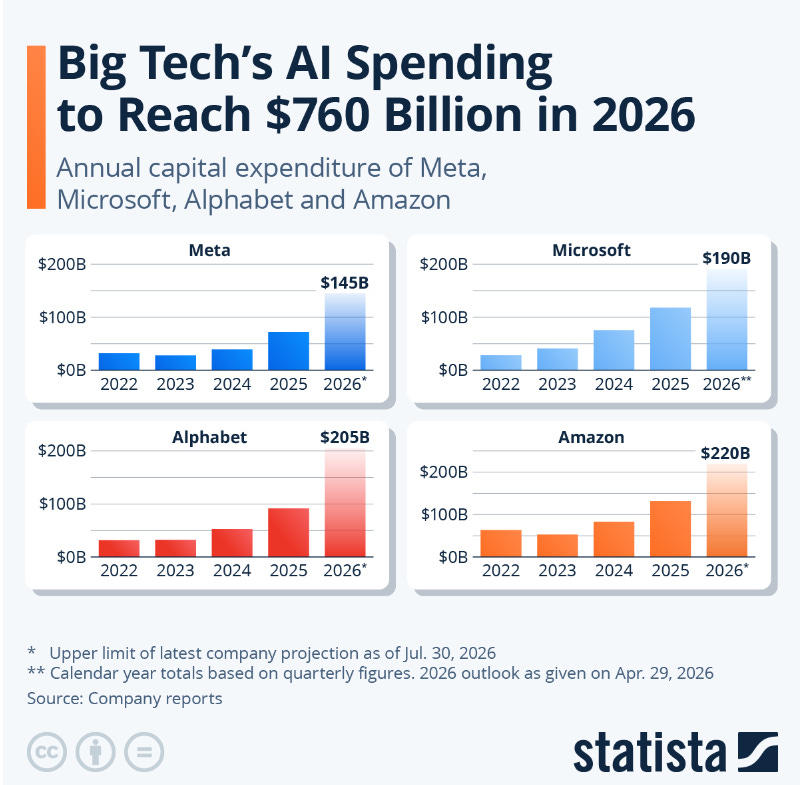
Recent earnings reports from Amazon, Microsoft, Alphabet, and Meta reinforced just how aggressive the current AI infrastructure buildout has become. Combined, the four companies are now expected to spend roughly $725 billion to $760 billion on capital expenditures this year, representing an increase of around 80% compared to the already record-breaking ~$410 billion spent last year.
A significant portion of this spending is being directed toward AI infrastructure, including data centers, networking equipment, GPUs, and custom AI accelerators. These systems require enormous amounts of memory to deliver the performance needed for modern AI workloads.
Amazon continues to lead the spending race, with approximately $200 billion in planned capex, driven by AWS expansion and investments in custom silicon.
Microsoft is tracking toward roughly $190 billion, with management highlighting that demand for AI infrastructure continues to exceed available supply.
Alphabet raised its capital expenditure outlook to $175 billion to $185 billion as it expands AI compute capacity and deploys additional TPU clusters.
Meta is planning $115 billion to $135 billion in infrastructure investments to support its AI models and data center expansion.
The latest earnings updates show that hyperscalers are not slowing their AI infrastructure investments. Instead, they continue to prioritize expanding compute capacity, creating sustained demand for the advanced chips and memory required to power these systems.
For the memory industry, this spending cycle is particularly important. Every new generation of AI infrastructure requires significantly more memory bandwidth and capacity, supporting continued demand for technologies such as HBM and next-generation AI memory solutions.
High-Bandwidth Flash (HBF): Complementary to HBM, Not a Replacement
SK Hynix officially unveiled High-Bandwidth Flash (HBF) on August 4, 2026, introducing a new layer to the AI memory ecosystem by addressing a challenge that HBM was not designed to solve.
Some investors have raised concerns that HBF could cannibalize HBM demand by replacing some of its use cases. However, the two technologies serve different roles within AI infrastructure and are designed to complement each other rather than compete.
As AI models continue to grow in size, keeping all model weights in HBM becomes increasingly expensive and impractical. HBM is built for maximum speed and sits directly alongside AI accelerators, making it ideal for active computation. However, its limited capacity and high cost make it unsuitable as the primary storage layer for increasingly large AI models.
This is where HBF comes into play.
HBF combines the high capacity and cost advantages of NAND flash with significantly faster interfaces, creating a new storage tier optimized for AI workloads. It allows large model weights and datasets to be accessed much faster than traditional storage solutions while allowing HBM to remain focused on the most latency-sensitive tasks.
The growth opportunity for HBF could be significant. Industry experts expect the technology to scale rapidly, with projections suggesting the HBF market could eventually surpass the size of the HBM market. For comparison, the HBM market itself is expected to grow at roughly a 30% to 42% CAGR, reaching over $100 billion by 2030.
In simple terms:
HBM enables fast computation.
HBF enables larger AI models and datasets.
As AI models continue to scale, demand for both technologies should increase. HBM remains critical for high-speed processing, while HBF expands the memory stack by providing a more efficient way to store and access massive amounts of AI data.
For companies like SK Hynix, Samsung, and Micron, HBF represents a new growth opportunity by turning traditional flash storage into a higher-value AI infrastructure product.
The rise of HBF highlights a broader trend: AI is increasing demand across the entire memory ecosystem, requiring both faster memory for computation and higher-capacity storage for increasingly complex models.
CXMT Enters the Global Memory Market
Another important development in the memory industry is the rise of ChangXin Memory Technologies (CXMT), China’s leading domestic DRAM manufacturer.
CXMT recently completed its IPO on the Shanghai Stock Exchange’s STAR Market, raising approximately $10 billion. Shares surged on the first day of trading as investors showed strong interest in China’s efforts to develop a more self-sufficient semiconductor ecosystem.
The company has already grown its global DRAM market share to around 8%, representing meaningful progress for a relatively young competitor entering a market historically dominated by Samsung, SK Hynix, and Micron.
CXMT’s growth has become one of the factors investors are monitoring when assessing the long-term outlook for memory pricing. Historically, the biggest challenge for memory manufacturers has been the return of excess supply, which can quickly pressure pricing and margins across the industry.
However, CXMT’s current impact remains limited. The company is primarily focused on mainstream DRAM products and has not yet reached the same level of capability in advanced HBM production as the leading suppliers. Additionally, U.S. export restrictions continue to limit access to some advanced semiconductor manufacturing equipment.
While CXMT’s expansion could become increasingly relevant over time, especially as China continues investing heavily in domestic semiconductor production, its ability to compete in the highest-value AI memory segment remains limited today.
Memory Companies Are Reporting Record Earnings
The largest memory manufacturers are already seeing the financial impact of the AI infrastructure boom, delivering some of the strongest results in their histories.
However, the more important takeaway is not just the record earnings. The companies are signaling that the current memory shortage could persist for several years as AI demand continues to absorb available capacity.
Micron Technology (MU)
Micron has emerged as one of the biggest beneficiaries of the AI memory cycle, driven by strong demand for server DRAM and high-bandwidth memory (HBM).
The company reported a record quarter, generating $41.46 billion in revenue and $28.86 billion in non-GAAP net income, while gross margins expanded to 84.9%.
Management highlighted that AI demand remains exceptionally strong, supported by long-term supply agreements with major customers.
Looking ahead, Micron stated that its entire HBM production capacity through 2026 and 2027 is already sold out, with HBM3E and next-generation HBM4 capacity allocated through non-cancellable agreements.
The company also expects continued margin strength, guiding fiscal Q3 gross margins toward 81% to 85%. Interestingly, management noted that conventional DDR5 server memory has recently become even more profitable than HBM due to significant pricing increases on high-capacity memory modules.
A major industry shift is also underway. Micron expects data center DRAM and NAND demand to represent more than 50% of the total memory market for the first time, highlighting how AI infrastructure is reshaping the industry.
The downside is that the supply shortage is beginning to impact consumer markets. Micron warned that rising memory prices and limited availability could pressure PC and smartphone shipments, potentially leading to low double-digit percentage declines in unit volumes.
SK Hynix (000660.KRX)
SK Hynix has been one of the biggest winners of the AI memory boom due to its leadership position in HBM, supplying some of the world’s largest AI accelerator platforms.
The company reported record quarterly revenue of KRW 79.32 trillion, a 257% year-over-year increase, alongside operating profit of KRW 60.54 trillion.
Operating margins reached approximately 76%, reflecting the pricing power created by strong AI-related memory demand.
Beyond the current results, management provided one of the strongest indications yet that the memory shortage could continue for years.
CEO Kwak Noh-jung stated that 2027 could become the most challenging year of the current memory shortage, with meaningful supply relief potentially not arriving until 2028 or later.
The reason is simple: existing fabs are already operating at maximum utilization. While global DRAM demand is expected to grow in the mid-20% range, SK Hynix expects its own bit output growth to increase by only around 10% sequentially due to capacity constraints.
To prepare for future demand, SK Hynix raised its capital expenditure plans into the high KRW 40 trillion range, funding projects such as the M15X fab and the Yongin semiconductor cluster. However, these new facilities are not expected to meaningfully increase supply until 2027 at the earliest.
The company is also accelerating its HBM roadmap, advancing HBM4E sampling while working with TSMC on advanced logic base dies.
Despite the strong fundamentals, the stock has experienced volatility as investors debate whether peak earnings expectations are already reflected in the valuation.
Samsung Electronics (005930)
Samsung also delivered exceptional results, with its semiconductor division benefiting from higher DRAM and NAND pricing alongside growing AI memory demand.
The company reported record quarterly revenue of KRW 171.5 trillion and operating profit of KRW 89.5 trillion.
Management expects memory supply conditions to remain tight as hyperscaler demand continues to exceed available manufacturing capacity.
Samsung provided one of the strongest warnings on the future supply environment, stating that memory constraints could become even more severe in 2027 and remain tight through 2028.
The company is already preparing by locking in long-term customer agreements. Samsung revealed that it is securing 60% to 70% of its memory wafer capacity through multi-year contracts with cloud providers and AI companies.
This shift represents a major change from the traditional memory cycle, where companies typically expanded aggressively during periods of high prices and later faced oversupply.
Samsung also highlighted that HBM4 and HBM4E production will require additional cleanroom space and advanced packaging capacity, further limiting near-term supply growth.
While the semiconductor business remains extremely strong, Samsung’s consumer electronics divisions are facing pressure from higher component costs, showing how the memory shortage is affecting the broader technology ecosystem.
Recent Outlook From The Memory Manufacturers
Across Micron, SK Hynix, and Samsung, the message is consistent: AI demand is growing faster than the memory industry can add supply.
Micron has its HBM capacity fully allocated through 2026 and 2027, with margins expected to remain elevated as pricing stays strong across both HBM and traditional server memory.
SK Hynix expects the supply shortage to become even more challenging in 2027, with meaningful capacity relief unlikely before 2028 due to limited available fab space and long construction timelines.
Samsung is also warning that supply constraints could worsen through 2027 and remain tight into 2028, with a significant portion of its memory capacity already secured through long-term agreements with cloud providers and AI companies.
The broader takeaway is that this cycle looks different from previous memory upcycles. Instead of manufacturers rapidly adding capacity and creating oversupply, AI demand is absorbing new production almost immediately.
While additional fabs and advanced packaging facilities are being built, the industry appears constrained for the next several years, creating a supportive environment for memory pricing and profitability.
The Narrative Behind the Bear Case
While the current memory cycle remains attractive, the thesis is not without risks. The two biggest factors to monitor are whether AI becomes significantly more memory-efficient and how quickly new supply enters the market.
AI Efficiency Improvements
One of the biggest long-term concerns for memory demand is that AI systems become significantly more efficient.
AI companies have enormous incentives to reduce infrastructure costs, and improvements in software, model architecture, and hardware design could eventually reduce the amount of memory required for certain workloads. Recent developments, such as Moonshot AI’s Kimi K3 model, have highlighted how advances in techniques like model compression and quantization can reduce hardware requirements while maintaining strong performance.Efficiency improvements do not automatically translate into lower memory demand. As AI systems become cheaper and more efficient, they could also enable broader adoption and create additional demand for compute infrastructure.
For now, the scale of AI investment from hyperscalers suggests that efficiency gains are being used to expand AI capabilities rather than reduce overall infrastructure spending.Cyclicality
The second major risk is that additional memory supply eventually catches up with demand.
Historically, excess supply has been the main factor that ends memory cycles. As manufacturers add capacity, pricing power can weaken and profitability can decline.New competitors and expanded capacity, including companies such as CXMT, remain important developments to monitor. However, the timing is critical.
Adding meaningful semiconductor capacity is a multi-year process. New fabs require significant investment, long construction timelines, and advanced manufacturing capabilities before they can materially impact global supply.
For now, the biggest constraint remains not demand, but the industry’s ability to increase supply quickly enough to meet it.
Overall, these are the key factors that will determine how long this memory cycle can last. Investors should continue monitoring the pace of AI infrastructure growth and whether future supply additions remain aligned with demand.
